03
Given a paired view of a star at varying distance from the observer, the learner answers in two parts: Q1 'How does this star look — disk or point?' (correct response: 'a disk' when close, 'a point' when far) and Q2 'Why?' (correct response: 'because it is close' / 'because it is far'). The learner applies the rule across multiple stars (the Sun and Proxima Centauri) and accepts that the same body looks like a disk OR a point depending on distance.
- grade level
- 5
- frames
- 18
You have mastered the rule for how we see stars. Any star looks like a disk when you are close to it, and a point when you are far away.
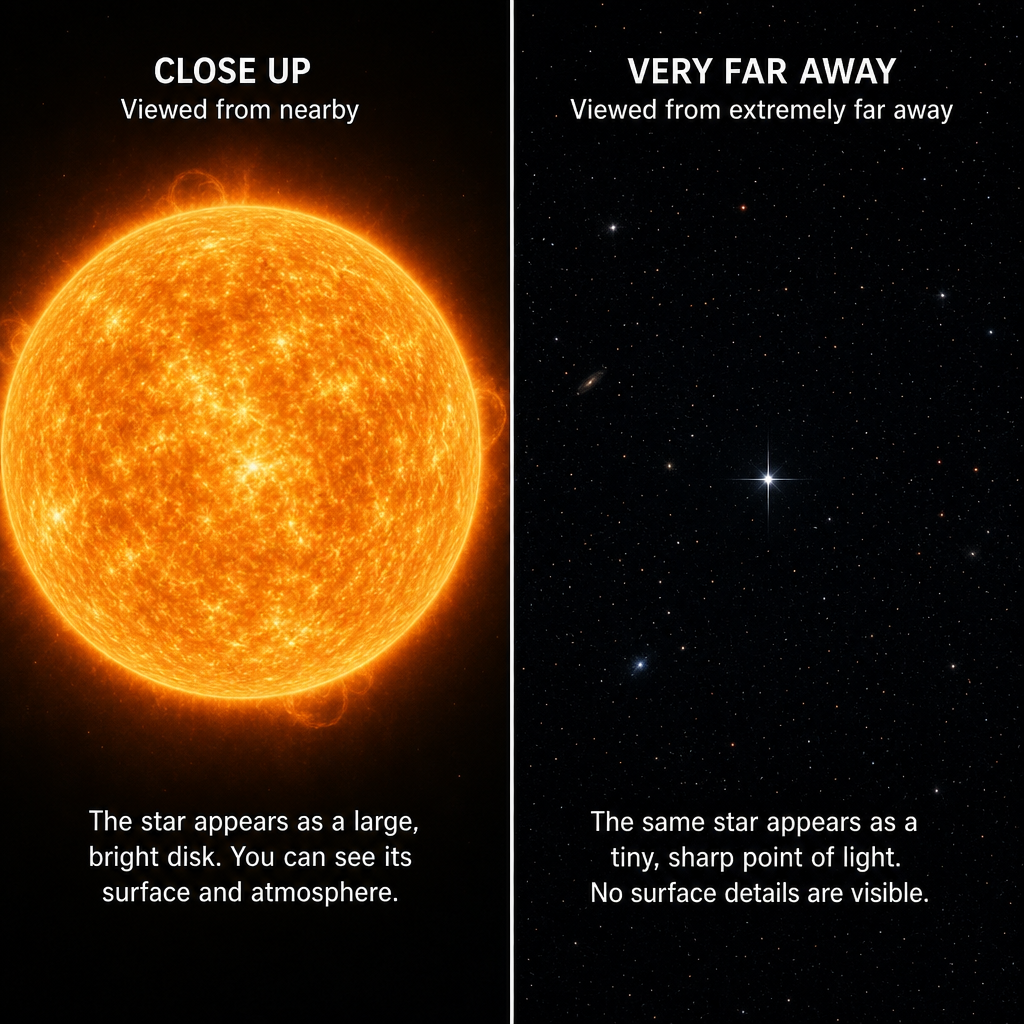
This image provides a helpful split-screen comparison that shows a star as a large, bright disk on one side when viewed from close up, and as a tiny, sharp point of light on the other side when viewed from extremely far away.