11

Given an image or animation of a body in space, the learner identifies it as an outer planet when (and only when) it is a large body, made mostly of gas/ice, far from the Sun (beyond the asteroid belt).

grade level
5
frames
20
  1. 01We call a big planet that is made mostly of gas and ice, and is located far from the Sun, an outer planet. Let's look at Jupiter. Jupiter is the largest planet in our solar system. Because it is a huge body, made mostly of gas, and orbits far from the Sun, we classify it as an outer planet.
  2. 02Saturn is famous for its prominent rings. But rings do not make a planet an outer planet. Saturn is an outer planet because it meets our three rules: it is much larger than Earth, it is made of gas and ice, and it is far from the Sun.
  3. 03Let's look at Uranus. It is a pale blue-green ice giant that is tilted sideways. Even with its unusual tilt, we can classify it as an outer planet because it is a massive body, made of ice and gas, and sits far from the Sun.
  4. 04To spot an outer planet, we have to look for the right features. This is the Sun. The Sun is massive and made of gas, but it is a star, not a planet. It produces its own light and sits at the very center of our solar system, so it is definitely not an outer planet.
  5. 05Let's look at a piece of granite rock on Earth. It is small, solid, and relatively close to the Sun. We do not call it an outer planet because it is not large, it is not made of gas or ice, and it is not far from the Sun.
  6. 06What kind of body is this, and why?
  7. 07Which description best fits this body?
  8. 08How should we classify this bright body?
  9. 09How would you describe this object?
  10. 10Which of the following statements best describes this body?
  11. 11Is this brown dwarf an outer planet in our solar system?
  12. 12How should we classify this small, solid body?
  13. 13What kind of body is this when we view it from this new angle?
  14. 14Do these visible cloud bands change what we call this body?
  15. 15Which classification is correct for this massive body?
  16. 16What is the best classification for this giant object?
  17. 17How should we classify this icy body?
  18. 18Which of the following statements is true about this body?
  19. 19How should we classify this bright body?
  20. 20Which classification perfectly applies to this object?

This pale blue-green body is an ice giant tilted on its side, located in the distant outer solar system.
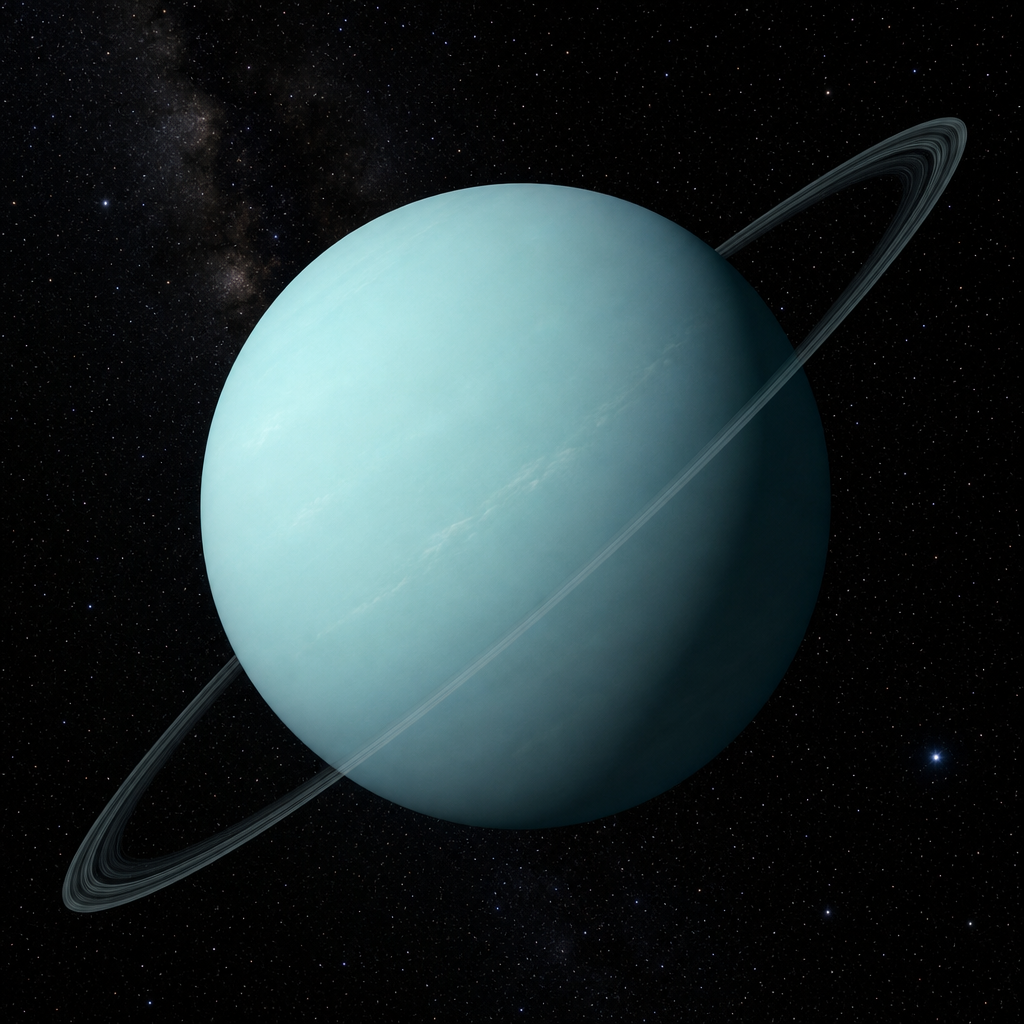
This is a striking view of Uranus, showing it as a smooth, pale blue-green globe in outer space. We can see the planet's unusual sideways tilt, and its massive size marks it clearly as a distant ice giant composed of frozen gases and icy materials.

Prompt

How should we classify this icy body?