15

Given an image or animation of a body in space, the learner identifies it as an asteroid when (and only when) it is a small rocky chunk in our solar system, typically (but not necessarily) found in the asteroid belt between Mars and Jupiter.

grade level
5
frames
20
  1. 01Our solar system is filled with objects that orbit the Sun. While the eight planets are the largest, there are millions of smaller bodies traveling through space with us.
  2. 02An asteroid is a small rocky chunk in our solar system. For us to call it an asteroid, the object must be small, it must be made of rock, and it must orbit the Sun rather than being a planet.
  3. 03This is Vesta, and it is an asteroid. Although it is large enough to be nearly spherical and is covered in craters, it is still a small rocky chunk compared to a planet. We can see it orbits the Sun in the asteroid belt.
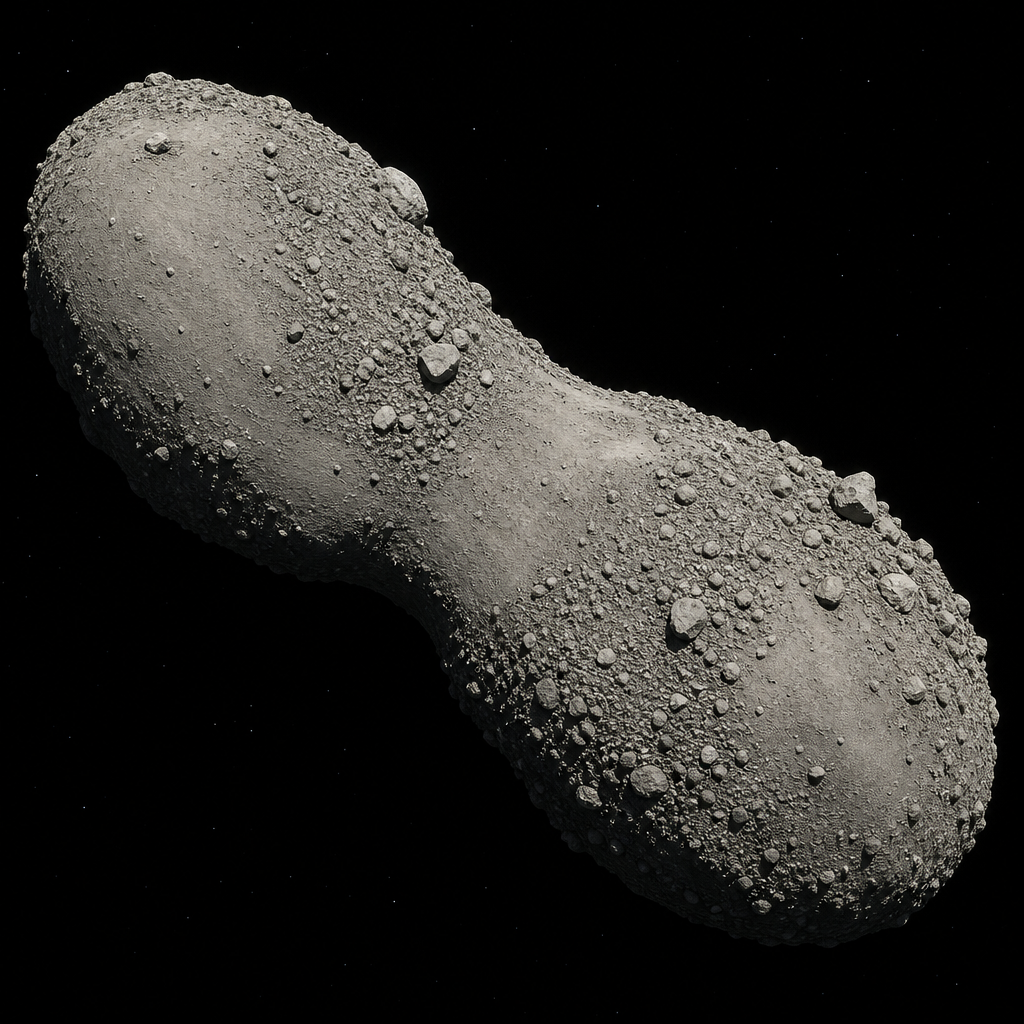
  4. 04This is Itokawa, and it is also an asteroid. As you can see, asteroids do not have to be round. Itokawa has an irregular, peanut-like shape, but it is still a small rocky chunk traveling through our solar system.
  5. 05This is Bennu, another asteroid. It is shaped almost like a diamond and has a surface that looks like a loose pile of gravel. No matter its shape or texture, we know it is an asteroid because it is a small rocky chunk in our solar system.
  6. 06Is the Sun an asteroid?
  7. 07Is Neptune an asteroid?
  8. 08Is Mars an asteroid?
  9. 09Most asteroids are found in the asteroid belt between Mars and Jupiter. However, we can find them elsewhere in our solar system as well.
  10. 10Some asteroids have orbits that bring them close to Earth. Even though they are not in the main asteroid belt, we still call them asteroids.
  11. 11Sometimes, a small rocky chunk enters Earth's atmosphere and burns up, creating a bright streak. Even as it falls toward the ground, we still call it an asteroid.
  12. 12Is this space body an asteroid?
  13. 13Is this space body an asteroid?
  14. 14Is this space body an asteroid?
  15. 15Is this space body an asteroid?
  16. 16Is this space body an asteroid?
  17. 17Is this space body an asteroid?
  18. 18Is this space body an asteroid?
  19. 19Is this space body an asteroid?
  20. 20Is this space body an asteroid?
A highly irregular, elongated space rock shaped very much like a giant peanut, known as Itokawa. You can see its distinctly two-lobed surface is divided between strangely smooth, dusty regions and extremely rough areas that are heavily covered in scattered boulders of various sizes.

Prompt

Is this space body an asteroid?